In semiconductor chip design, the Analog-to-Digital Converter (ADC) is a critical component in many modern electronic systems. From smart sensors and the Internet of Things (IoT) to communication systems and artificial intelligence (AI), ADC technology serves as a bridge between physical-world signals and digital processing systems.
Scientists from the Information Technology Institute (ITI), Vietnam National University, Hanoi (VNU), have proposed a novel signal conversion method based on a Voltage-Controlled Oscillator (VCO), combining signal enhancement techniques with multi-level time-domain Delta-Sigma modulation. This innovative approach opens up new possibilities for the design of next-generation semiconductor integrated circuits.
 |
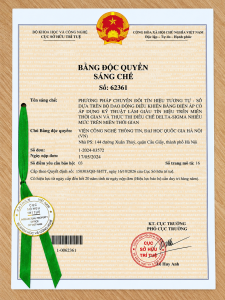
The invention, entitled “An Analog-to-Digital Conversion Method Based on a Voltage-Controlled Oscillator Incorporating Time-Domain Signal Enhancement and Multi-Level Time-Domain Delta-Sigma Modulation,” has been named MuMu VCO-ADC by the research team.
The invention was researched and proposed by scientists from the Center for Integrated Circuit Design and Applications (CICA), Information Technology Institute (ITI), Vietnam National University, Hanoi (VNU).
 |
The research team comprises Prof. Tran Xuan Tu, Head of the strong research group on Smart Integrated Systems (SISLAB) and Director of the Information Technology Institute, VNU; Mr. Tran Duc Manh, who has completed his Master’s degree program in Semiconductor Chip Design at National Yang Ming Chiao Tung University, Taiwan, China; and Dr. Bui Duy Hieu, Head of the AIoT Laboratory at ITI, who earned his PhD from Université Grenoble Alpes, France.
A Time-Domain Approach to Effectively Harness the Potential of CMOS Technology
In electronic systems, signals from the real world, such as sound, light, temperature, and pressure, typically exist in analog form. For digital processors to receive and analyze these signals, they must first be converted into digital data using an Analog-to-Digital Converter (ADC).
Traditional ADCs typically perform quantization based on voltage levels and use voltage comparators to determine signal values. However, as CMOS technology continues to scale down and supply voltages decrease, maintaining a wide dynamic range and a high signal-to-noise ratio (SNR) has become increasingly challenging for voltage-based conversion architectures.
An emerging approach attracting growing interest among researchers is Time-Domain Analog-to-Digital Conversion (Time-Domain ADC). Rather than directly encoding information through voltage levels, this method exploits the timing characteristics of signals, such as the frequency or phase of an oscillator. By leveraging fundamental digital circuit structures, this approach can better align with semiconductor scaling trends and support the development of highly integrated microchip systems.
 |
| Research group at VNU Information Technology Institute |
Building on this approach, the research team at the Information Technology Institute (ITI), Vietnam National University, Hanoi (VNU), has developed the MuMu VCO-ADC architecture, which integrates two core techniques: time-domain signal enrichment and multi-level time-domain Delta-Sigma modulation.
Combining Two Techniques to Differentiate the VCO-ADC Architecture
The key innovation of the MuMu VCO-ADC invention lies in integrating two signal-processing techniques within a single conversion architecture.
First, Time-Domain Signal Enrichment leverages the potential of a ring-structured Voltage-Controlled Oscillator (VCO) to enhance the representation and processing of signal information through its timing characteristics.
Second, Multi-Level Time-Domain Delta-Sigma Modulation expands the modulation capabilities and makes more effective use of the oscillator’s operating frequency range, with the aim of improving the resolution and quality of the digital output signal.
The integration of these two techniques distinguishes MuMu VCO-ADC from previous VCO-based Delta-Sigma ADC architectures, which have primarily relied on single-phase or multi-phase configurations combined with conventional single-level Delta-Sigma modulation.
 |
Rather than relying solely on information derived from a single modulation level, the proposed method aims to make more effective use of signal states in the time domain, thereby expanding the information-processing capabilities of the converter.
Unlocking Potential Applications in Next-Generation Integrated Circuit Systems
Sharing further insights into the potential applications of this technology in next-generation integrated circuit systems, Prof. Tran Xuan Tu, Head of the Strong Research Group on Smart Integrated Systems (SISLAB) and Director of the Information Technology Institute, VNU, stated:
“The MuMu VCO-ADC invention contributes an additional approach to the research and design of analog-to-digital converters, particularly as the semiconductor industry faces increasingly demanding requirements in terms of chip performance, power consumption, and integration density.”

Prof. Tran Xuan Tu – Head of the Strong Research Group on Smart Integrated Systems (SISLAB) and Director of the Information Technology Institute, Vietnam National University, Hanoi (VNU).
By leveraging the timing characteristics of signals and incorporating multi-level modulation techniques, this architecture holds potential for further research, development, and applications in signal acquisition and processing systems, smart sensors, Internet of Things (IoT) devices, embedded electronics, and next-generation integrated circuit platforms.
Notably, research into time-domain ADC architectures is particularly relevant to the advancement of advanced CMOS technologies, as optimizing performance and energy consumption has become increasingly important for modern electronic devices.
 |
The invention also demonstrates the effective combination of the research experience of highly qualified scientists with the capabilities of engineers and researchers who have received specialized training in semiconductor technologies in an international academic environment. This provides an important foundation for developing research teams capable of accessing, mastering, and gradually innovating core technologies.
Through its research and development of integrated circuit design solutions, the Information Technology Institute (ITI), Vietnam National University, Hanoi (VNU), continues to reinforce its role in training highly skilled human resources, advancing scientific research, and promoting innovation in strategic technology fields. Achievements such as MuMu VCO-ADC contribute to realizing Vietnam’s ambition to strengthen its research and design capabilities and achieve greater mastery of semiconductor technologies.